Read our comprehensive clinical guides online below, or download the printable versions to keep as a handy reference for your daily foot care routine and mobility support.
1. Plantar Fasciitis
What is Plantar Fasciitis?
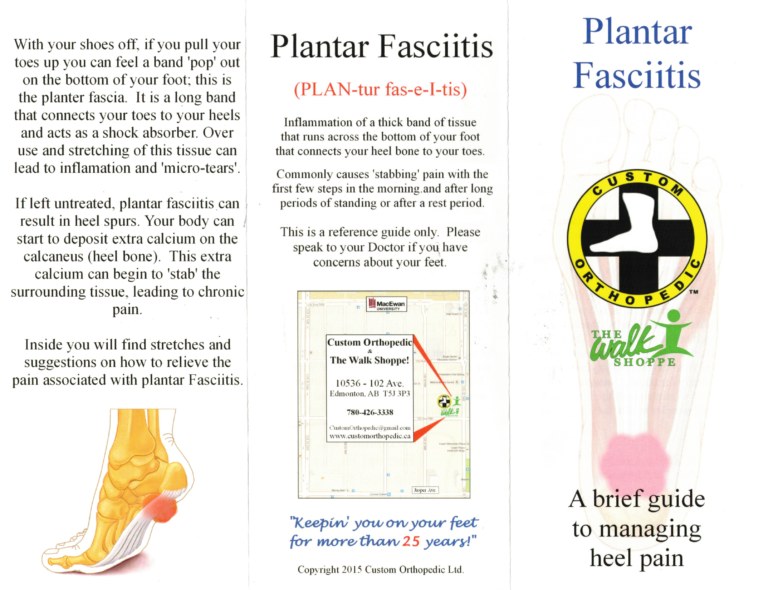
Plantar Fasciitis (PLAN-tur fas-e-I-tis) is the inflammation of a thick band of tissue that runs across the bottom of your foot that connects your heel bone to your toes. It commonly causes 'stabbing' pain with the first few steps in the morning, and after long periods of standing or after a rest period.
The Anatomy of Heel Pain
With your shoes off, if you pull your toes up you can feel a band 'pop' out on the bottom of your foot; this is the plantar fascia. It is a long band that connects your toes to your heels and acts as a shock absorber. Overuse and stretching of this tissue can lead to inflammation and 'micro-tears'.
If left untreated, plantar fasciitis can result in heel spurs. Your body can start to deposit extra calcium on the calcaneus (heel bone). This extra calcium can begin to 'stab' the surrounding tissue, leading to chronic pain. Read below for stretches and suggestions on how to relieve the pain associated with Plantar Fasciitis.
Save this guide:
2. Middle Of The Day Stretch & Heel Pain Treatments
Morning Pain?
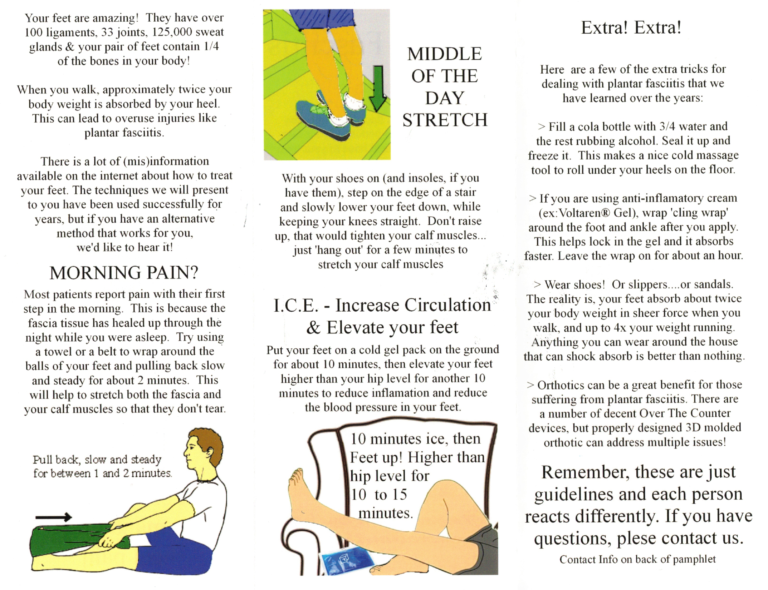
Most patients report pain with their first step in the morning. This is because the fascia tissue has healed up through the night while you were asleep. Try using a towel or a belt to wrap around the balls of your feet and pulling back slow and steady for between 1 and 2 minutes. This will help to stretch both the fascia and your calf muscles so that they don't tear.
Middle of the Day Stretch
With your shoes on (and insoles, if you have them), step on the edge of a stair and slowly lower your feet down, while keeping your knees straight. Don't raise up, that would tighten your calf muscles... just 'hang out' for a few minutes to stretch your calf muscles.
I.C.E. - Increase Circulation & Elevate
Put your feet on a cold gel pack on the ground for about 10 minutes, then elevate your feet higher than your hip level for another 10 to 15 minutes to reduce inflammation and reduce the blood pressure in your feet.
Extra! Extra! Tricks for Heel Pain Relief
- Ice Massage: Fill a cola bottle with 3/4 water and the rest rubbing alcohol. Seal it up and freeze it. This makes a nice cold massage tool to roll under your heels on the floor.
- Wrap It Up: If you are using anti-inflammatory cream (ex: Voltaren® Gel), wrap 'cling wrap' around the foot and ankle after you apply. This helps lock in the gel and it absorbs faster. Leave the wrap on for about an hour.
- Wear Shoes!: Or slippers....or sandals. The reality is, your feet absorb about twice your body weight in sheer force when you walk, and up to 4x your weight running. Anything you can wear around the house that can shock absorb is better than nothing.
- Orthotics: Custom orthotics can be a great benefit for those suffering from plantar fasciitis. Properly designed 3D molded orthotics can address multiple issues!
Save this guide:
3. Amazing Feet! The 5 Components of Support Shoes
Your Feet Are Amazing!
Your feet contain 1/4 of the bones for your entire body! The average North American takes between 7,000 and 10,000 steps per day. In a lifetime that's about the same as going around the world over 4 times! Just from morning to night most people will experience between 5% and 8% swelling. This is typically between 1/2 and a full size of change. The following are just guidelines on how to purchase supportive footwear that should help treat a variety of conditions.
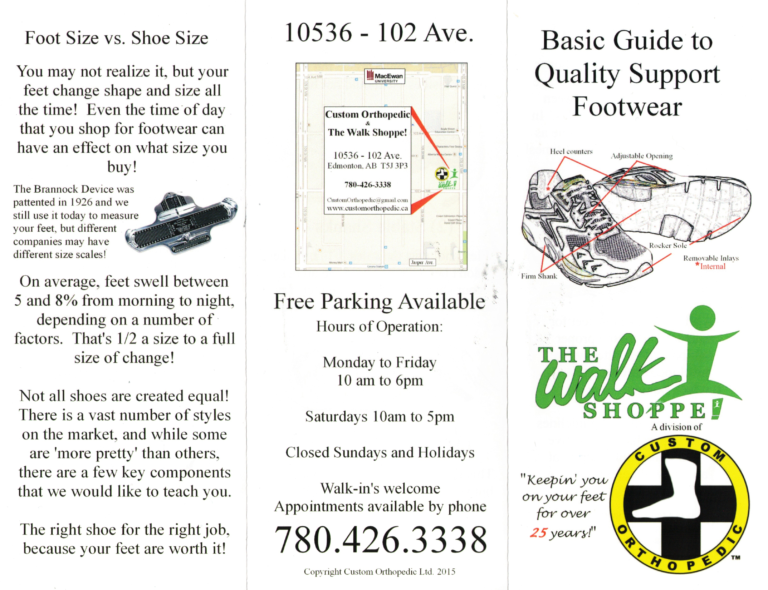
Basic Guide to Quality Support Footwear
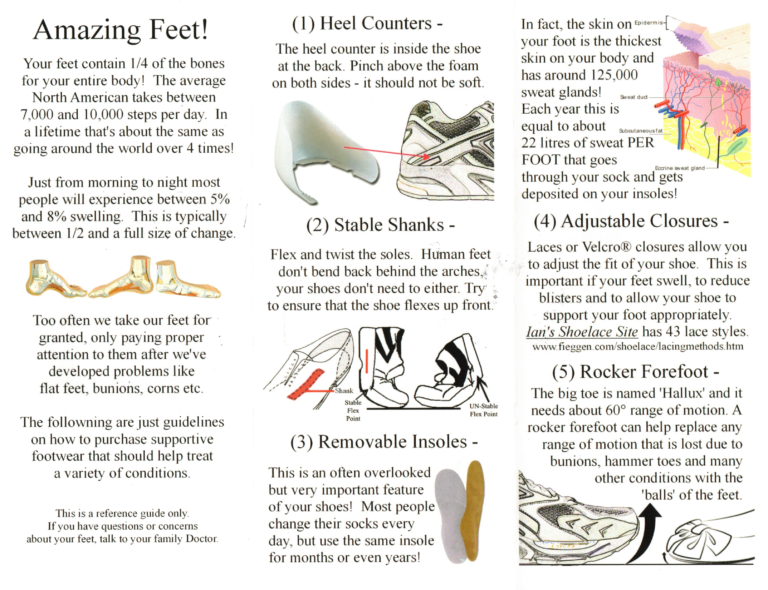
- (1) Heel Counters: The heel counter is inside the shoe at the back. Pinch above the foam on both sides - it should not be soft.
- (2) Stable Shanks: Flex and twist the soles. Human feet don't bend back behind the arches, your shoes don't need to either. Try to ensure that the shoe flexes up front.
- (3) Removable Insoles: This is an often overlooked but very important feature of your shoes! Most people change their socks every day, but use the same insole for months or even years!
- (4) Adjustable Closures: Laces or Velcro® closures allow you to adjust the fit of your shoe. This is important if your feet swell, to reduce blisters and to allow your shoe to support your foot appropriately.
- (5) Rocker Forefoot: The big toe is named 'Hallux' and it needs about 60° range of motion. A rocker forefoot can help replace any range of motion that is lost due to bunions, hammer toes and many other conditions with the 'balls' of the feet.
Save this guide:
4. Foot Size Vs Shoe Size
Foot Size vs. Shoe Size
You may not realize it, but your feet change shape and size all the time! Even the time of day that you shop for footwear can have an effect on what size you buy!
The Brannock Device was patented in 1926 and we still use it today to measure your feet, but different companies may have different size scales! On average, feet swell between 5 and 8% from morning to night, depending on a number of factors. That's 1/2 a size to a full size of change!
Not all shoes are created equal! There is a vast number of styles on the market, and while some are 'more pretty' than others, there are a few key components that we would like to teach you. The right shoe for the right job, because your feet are worth it!
Have questions about your footwear or sizing? Contact The Walk Shoppe & Custom Orthopedic in Edmonton today for a professional assessment.
Save this guide:

