Shoes for bunions should suit the things you want to do, whether that means a neighbourhood walk, a family gathering, or a holiday with plenty of sightseeing. When you have a bunion, choosing that footwear can involve more thought than picking a colour and your usual size.
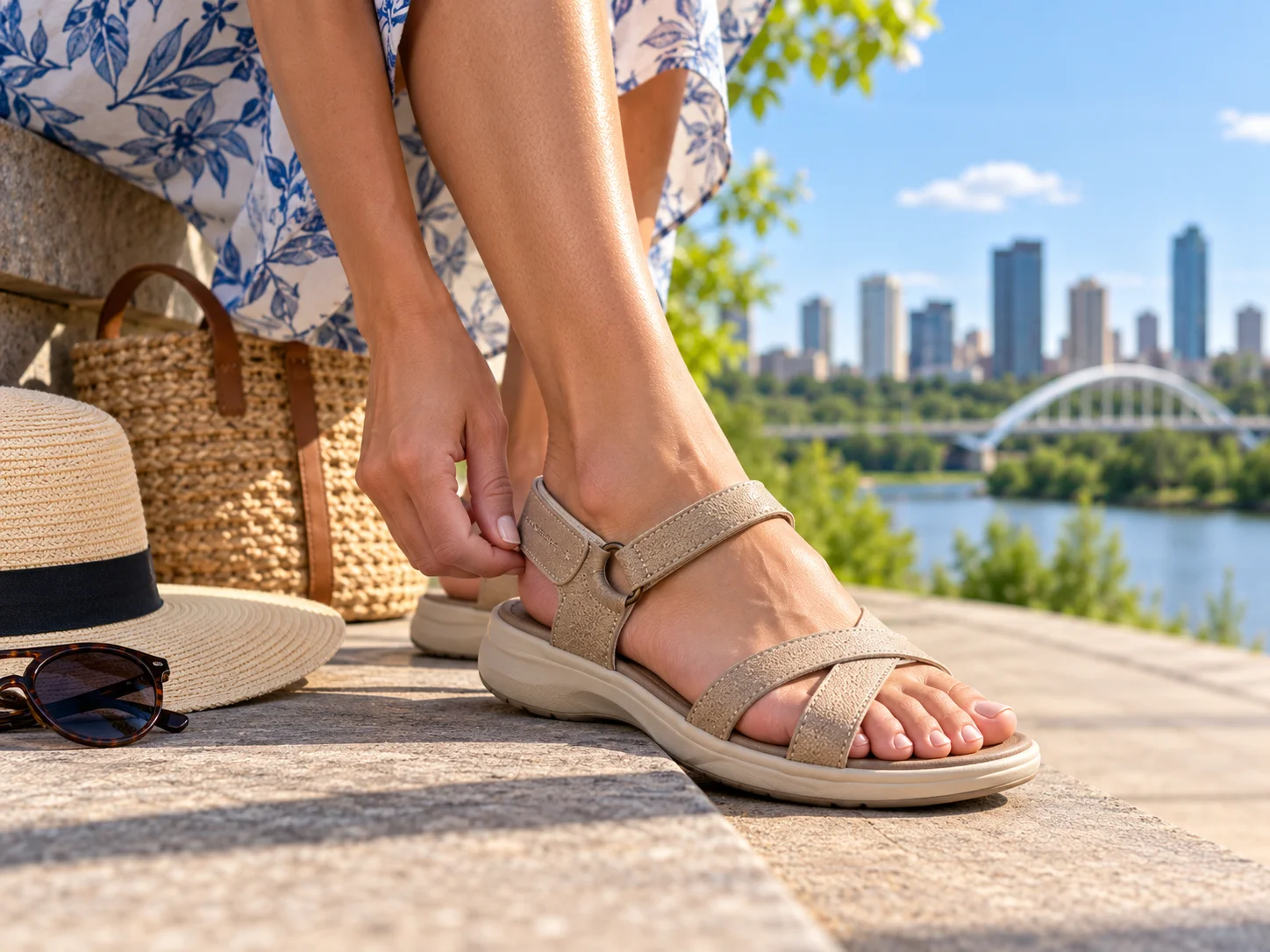
Perhaps a sandal strap lands directly on the sore spot. Maybe a walking shoe feels comfortable everywhere except the big toe joint. Or you have started buying longer shoes without finding the extra room you actually need.
The answer is not necessarily to avoid sandals or purchase the widest shoe available. It is to understand where your foot needs space and how the whole shoe fits.
Here is what to consider when choosing shoes for bunions in Edmonton. Our foot conditions guide also explains how foot shape can affect everyday footwear.
7 Summer Fitting Checks for Shoes for Bunions
- Check that the toe box follows the shape of your foot.
- Compare width and depth instead of automatically buying a longer size.
- Check where seams and sandal straps contact the big toe joint.
- Walk in each pair to assess heel security and overall comfort.
- Try the footwear with your prescribed orthotics when applicable.
- Test the footwear before committing to a long summer outing.
- Seek professional advice when pain persists despite footwear changes.
Understanding Bunions Before Choosing Summer Shoes
A bunion is a prominence at the joint near the base of the big toe. It is associated with changes in alignment, often with the big toe angling towards the smaller toes. The area can become tender, and pressure from footwear may make it uncomfortable.
The NHS bunion guidance discusses symptoms and treatment options. Inherited foot structure and other factors can contribute. Tight footwear can aggravate the problem, but having a bunion does not mean you simply chose the wrong shoes.
The practical challenge is accommodating the shape of your foot without squeezing the joint or allowing the rest of your foot to slide around.
A useful starting point is to describe the problem precisely. Does discomfort occur immediately, after standing, or only in one particular pair? Is the pressure beside the joint, underneath it, or between the toes? These details give your fitter and healthcare professional more useful information than “my shoes hurt.”
Choosing Shoes for Bunions: Start With the Toe Box
The toe box is the front section of a closed shoe. Its shape, width, and depth all influence how much room your toes have.
A rounded or square-shaped front can provide more usable space than a sharply tapered design. Depth matters too, particularly when toes overlap or another toe sits higher than usual. Extra length alone does not solve these shape differences.
When comparing shoes for bunions, look at each pair from above before trying it on. Does its outline resemble your foot, or does it narrow where you need room?
For example, imagine two shoes with the same size label. One has a gently rounded front, while the other narrows quickly towards the toe. Those shoes are not interchangeable simply because the number matches.
Use the label to begin the fitting, not to overrule what you feel once you stand and walk.
Do Not Confuse More Length With the Right Width
Buying a bigger size can seem like an obvious answer when a shoe presses against a bunion. However, the goal is appropriate room around the forefoot, not extra empty space everywhere.
Footwear guidance recommends checking length, width, and depth separately, with the ball of the foot fitting comfortably in the widest part of the shoe. Both feet should be assessed because they may differ in size.
Consider a shoe that finally stops squeezing the joint but now allows your heel to slip. That is not necessarily a successful compromise. It may be a reason to try a different shape or width rather than another increase in length.
During a fitting, explain which part improved and which part became worse. That comparison is useful. “This gives my bunion room, but the heel moves” provides a much clearer starting point than simply requesting the next size up.
Check Materials, Seams, and Reinforcements
Shoes for bunions can have enough overall space and still press against one sensitive area.
Pay attention to what sits over the bunion. A stiff seam, decorative overlay, or reinforced panel may be less forgiving than the surrounding upper material. The Pedorthic Association of Canada recommends avoiding seams or plastic pieces directly over a prominent or sensitive area and looking for materials that accommodate the foot.
Feel inside the shoe and compare that construction with the location of your discomfort. Then check again while standing.
This is especially useful when two similar-looking styles feel different. The issue may not be the brand or the size. It may be where one panel ends or a seam crosses the joint.
Do not buy a painful shoe on the assumption that a stubborn area will eventually soften enough. Proper fit should be present at purchase, not depend on a hoped-for transformation.
Choosing Sandals: Straps Matter as Much as Openness
Sandals can work for people with bunions, but an open front does not automatically make a sandal comfortable.
The sole needs to accommodate the whole foot, without the forefoot hanging over its edges. Straps should avoid concentrated pressure on the bunion. Adjustable closures can help balance room at the front with a secure fit elsewhere.
Try adjusting the sandal while standing, then walk in it. Notice whether the strap stays clear of the sensitive area or moves onto it with each step.
A practical comparison is to try two designs with different strap positions. One may cross directly over your sore joint, while another secures the foot farther back. That distinction may matter more than which sandal appears wider on the shelf.
Explain how you plan to use your shoes for bunions. A sandal intended for short outings should not automatically become the only shoe you pack for a walking-heavy holiday.
Look Beyond Cushioning to Overall Support
A soft footbed can feel appealing when you first step onto it, but that first impression is only part of the fitting.
Consider whether your foot stays securely positioned and whether the base accommodates its shape. The Pedorthic Association of Canada highlights sandal width, fastening, and sole construction as important features to assess together.
Walk rather than judging solely while seated. Turn around, change direction, and pay attention to whether you are adjusting your stride to keep the footwear in place.
Low-heeled, roomy footwear is commonly recommended for bunion discomfort. High heels and tight, pointed designs can increase pressure on the front of the foot or crowd the toes.
For a summer event, start with those practical requirements, then compare the styles that meet them. Appearance and comfort do not need to be treated as opposite goals, but appearance should not be used to explain away pain.
Fitting Shoes for Bunions With Custom Orthotics
Orthotics may be recommended to help redistribute pressure or support foot function, depending on your assessment. They do not remove a bunion or permanently straighten its underlying bony alignment. Footwear changes and other nonsurgical measures primarily aim to manage symptoms.
An orthotic also needs an appropriate shoe. Bring your existing devices when shopping and try them in the actual footwear you are considering. Removable factory insoles can create space for prescribed inserts, but the final combination must still fit comfortably.
Check whether adding the orthotic changes the room over your toes, the pressure beside the bunion, or the way your heel sits.
Do not assume that a shoe fitting well without the insert will fit equally well once it is added. Ask the fitter to assess the complete combination.
For sandals, discuss compatibility before purchasing. A custom orthotics insert and a sandal should be evaluated together rather than treated as separate purchases that will somehow work out later.
Make Your Fitting Reflect Real Life
When fitting shoes for bunions, bring the socks you expect to wear with closed shoes, along with your current footwear and any prescribed orthotics.
Foot and ankle specialists recommend shopping when your feet are at their larger end-of-day size and walking in both shoes before deciding. Feet and shoe sizing can change, so your previous size is a starting point rather than a permanent rule.
Explain the situation you want the footwear to handle. There is a difference between attending a mostly seated dinner and spending the afternoon walking between shops.
Ask practical questions during the appointment: Is there adequate room beside the joint? Does the shoe hold the heel without squeezing the forefoot? Is the pressure coming from the shape, the material, or the orthotic combination?
There is no advantage in quietly tolerating a problem during the fitting. Mention it while another size or design is available to compare.
Plan Summer Outings Around Footwear You Have Tested
A new pair should not have its first serious trial on the longest day of your holiday.
Begin with manageable wear in circumstances where you can stop and assess comfort. This is a practical test of your purchase, not an invitation to force your feet through persistent pain.
For example, try the shoes during an ordinary local outing before relying on them for an entire day away. Consider what you would do if a strap became uncomfortable or the weather changed.
For a trip with several types of activity, plan footwear by purpose. Your walking pair, event footwear, and casual sandals do not have to perform exactly the same job.
Keep a familiar, comfortable alternative available when feasible. The point is not to pack a shoe for every possible event. It is to avoid making a single untested pair responsible for your entire summer itinerary.
Be Careful With Pads and Toe Accessories
Bunion pads and other accessories may reduce rubbing for some people, but they also occupy space.
The Canadian Orthopaedic Association (AAOS guidance on bunions and footwear) warns that a pad can increase pressure over a bunion when there is not enough room inside the shoe. Test any recommended accessory briefly and assess the fit again. Toe spacers or splints may help selected symptoms, but they have not been shown to permanently correct a bunion.
Avoid solving one pressure point by creating another. A shoe, orthotic, pad, and toe accessory should not be treated as independent additions.
Bring accessories you already use to your fitting. Explain what helps, what feels crowded, and whether a healthcare professional recommended them.
This makes it easier to assess the arrangement you actually wear rather than a simplified version that only exists during the appointment.
When Footwear Changes Are Not Enough
Arrange a medical assessment when pain persists, limits normal activities, or continues despite more accommodating shoes. A healthcare professional can assess whether the problem is a bunion, another joint condition, or a combination of issues. A suddenly hot, very painful, swollen joint should not automatically be dismissed as ordinary bunion discomfort.
Extra care is important when you have diabetes or reduced sensation. A blister or area of skin damage may be less noticeable, and continued pressure can allow it to worsen. Check your feet and seek prompt advice about new wounds or concerning changes.
A footwear fitting can help with fit and pressure management, but it does not replace medical evaluation of a changing or unexplained problem.
You also do not need to wait until walking becomes extremely difficult before asking for help. Earlier questions can clarify which changes are worth trying and when additional assessment is appropriate.
Common Questions About Shoes for Bunions And Summer Footwear
Should I Choose a Bigger Size or a Wider Style?
Have the fit assessed rather than deciding from the label alone. A longer shoe and a wider shoe change different aspects of the fit. The best comparison is how each option accommodates your forefoot while keeping the rest of your foot comfortable and secure.
Can Comfortable Shoes Make the Bunion Disappear?
No. Roomier footwear can help reduce irritation, but symptom relief is different from reversing the change in joint alignment. Be cautious about products promising permanent correction simply from wearing a particular shoe. Discuss persistent symptoms with a healthcare professional.
What Should I Bring to My Appointment?
Bring your everyday shoes, any prescribed orthotics, and the socks or accessories you normally wear. Include a pair that feels comfortable as well as one that causes difficulty. Comparing those examples gives the fitting conversation a concrete starting point.
A note about where the pain occurs and how long you can comfortably wear each pair can be useful too.
Find Shoes for Bunions in Edmonton
At Custom Orthopedic & The Walk Shoppe, we focus on in-store footwear fitting because a size label or product photograph cannot show how a shoe works on your foot. Our approach includes assessing footwear alongside your gait and custom orthotics when applicable.
Bring the shoes that have been causing difficulty, your current orthotics, and a clear idea of your summer plans. That gives us a practical starting point for discussing shape, width, materials, and fit.
Explore our footwear brands and arrange a footwear fitting. Visit us at 10536 102 Avenue NW, Edmonton, or call 780-426-3338 to ask about footwear fitting.
The goal when choosing shoes for bunions is not to hide a bunion at the expense of comfort or promise that a shoe will reverse it. It is to find footwear that accommodates your feet and supports the activities you enjoy.
This article provides general information and does not replace individualized medical advice.