Summer in Alberta is glorious, but it is incredibly short. When the snow finally melts and the temperatures rise, Edmontonians are quick to pack away their heavy winter boots and break out the summer wardrobe. However, while your toes might love the fresh air, the sudden switch to summer footwear is often a complete disaster for your foot health.
Every June, our clinic sees a massive spike in patients complaining of severe heel, arch, and lower back pain. The culprit is almost always the same: they have abandoned the supportive shoes and custom orthotics they wore all winter in favor of completely flat, unsupportive sandals and flip-flops.
Many people mistakenly believe that their custom orthotics are strictly meant for running shoes or work boots, forcing them to choose between enjoying summer fashion and walking pain-free. We are here to tell you that you do not have to make that compromise.
In this comprehensive guide, we will break down why cheap summer footwear destroys your feet, how to find orthotic-friendly sandals, and the exact features you need to look for to wear custom orthotics with sandals comfortably all season long.
The Flip-Flop Epidemic: Why Summer Shoes Hurt
To understand how to fix summer foot pain, you first need to understand why standard summer footwear is so damaging. The human foot was not designed to walk on flat, hard concrete while wearing nothing but a thin piece of foam held on by a rubber Y-strap.
When you slide into a standard, $10 pair of pharmacy flip-flops, several biomechanical disasters occur simultaneously:
1. Zero Arch Support
Standard flip-flops and trendy fashion sandals are entirely flat. When you stand on a flat surface without support, your arches are forced to bear the brunt of your body weight. For individuals who already suffer from flat feet (overpronation), this leads to an immediate collapse of the arch. The connective tissues under the foot overstretch, leading to chronic inflammation. If you naturally have flat feet, you can review our guide on pes planus to see why this lack of support is so detrimental.
2. The “Toe-Grip” Mechanism
In a proper shoe, the laces hold the footwear securely to your foot. In a flip-flop, there is nothing securing the heel. To keep the sandal from flying off mid-stride, your toes are forced to instinctively “grip” or claw at the footbed with every single step. This constant, unnatural clenching severely overworks the tendons in your toes and the muscles in your shins, leading directly to shin splints and hammer toes.
3. Altered Gait and Shorter Strides
Because you are unconsciously trying to keep the flip-flops on your feet, your entire walking pattern (gait) changes. You take shorter strides, you don’t strike your heel properly, and your ankles roll inward. This altered gait sends shockwaves of misalignment straight up your kinetic chain. This is why a day of walking around the Edmonton Folk Fest in bad sandals often results in a throbbing lower back. If your back is aching, your footwear is likely the trigger—read more about the 5 signs your feet are messing up your knees, hips, or back.
Common Summer Foot Injuries
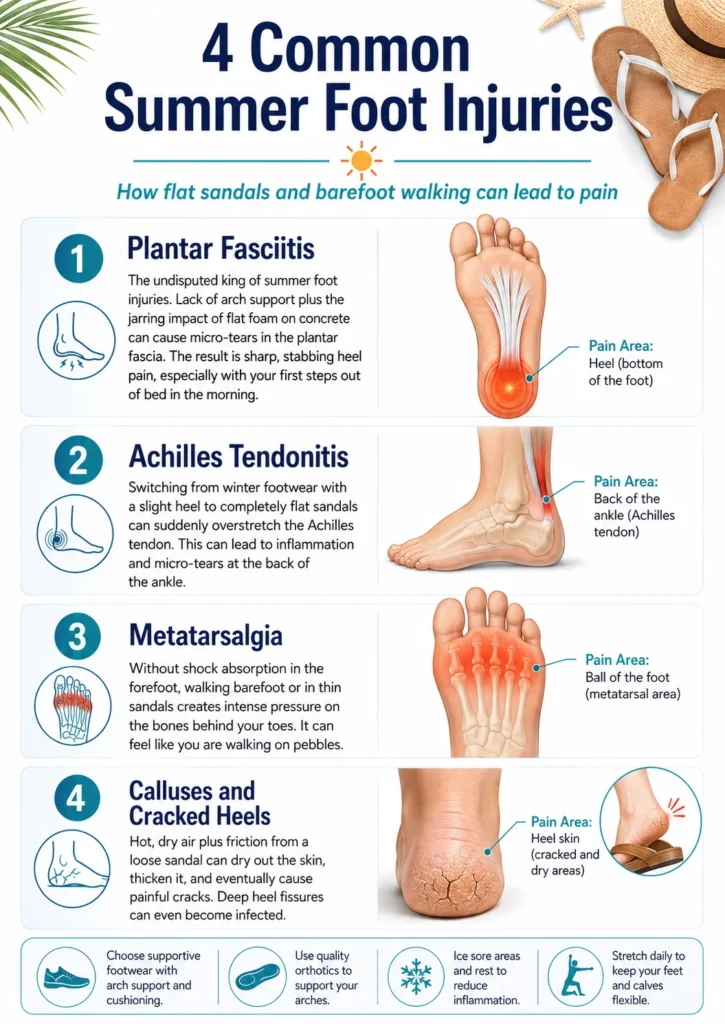
Ignoring the warning signs of bad footwear doesn’t just result in sore feet at the end of the day; it causes acute medical conditions that can sideline your entire summer vacation.
- Plantar Fasciitis: This is the undisputed king of summer foot injuries. The lack of arch support combined with the jarring impact of flat foam on concrete causes micro-tears in the plantar fascia. The result is a sharp, stabbing pain in your heel when you step out of bed in the morning. Learn more about managing this in our guide to plantar fasciitis footwear.
- Achilles Tendonitis: Many women switch from wearing slightly elevated heels or boots in the winter to completely flat sandals in the summer. This sudden drop in heel height violently stretches the Achilles tendon, causing inflammation and micro-tears at the back of the ankle.
- Metatarsalgia (Ball of Foot Pain): Without shock absorption in the forefoot, walking barefoot or in thin sandals puts immense, localized pressure on the bones behind your toes, making it feel like you are walking on pebbles.
- Calluses and Cracked Heels: Exposure to hot, dry air combined with the friction of your heel slapping against the back of a loose sandal causes the skin to dry out, thicken, and eventually crack. Deep heel fissures can become incredibly painful and even infected.
The Big Question: Can You Wear Custom Orthotics With Sandals?
The short answer is yes, absolutely. But there is a catch: you cannot wear them with every sandal.
You cannot simply tape or glue a custom orthotic onto a flat flip-flop. Standard sandals lack the physical depth and the necessary securing straps to hold a medical device in place. If you place an orthotic on top of a standard sandal, your foot will sit too high, and you will slide right off the side, risking a severe ankle sprain.
To wear custom orthotics with sandals, you must purchase footwear specifically engineered for orthopedic use. These are often referred to as “orthotic-friendly sandals.”
How to Shop for Orthotic-Friendly Sandals
If you are heading to the shoe store or browsing online, you need to know exactly what structural features to look for. Bringing the wrong summer shoes to an orthotics fitting is a common and frustrating mistake.
Here are the non-negotiable features your summer footwear must have:
1. Removable Footbeds (The Golden Rule)
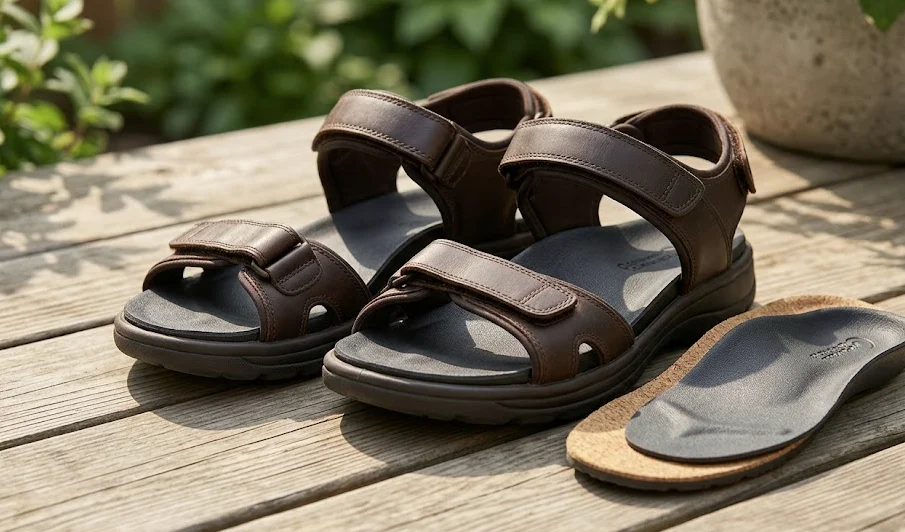
This is the single most important feature. Just like an orthotic-friendly winter boot, an orthotic-friendly sandal must have a removable insole. The factory footbed (usually held in place by strong Velcro) must be completely lifted out to create a deep, recessed cavity. Your custom orthotic is then placed directly into this empty space, ensuring it sits flush with the edges of the sandal.
2. Deep Heel Cups
A custom orthotic has a contoured heel cup to stabilize your ankle. The sandal housing it must also have a deep, rigid heel counter to hide the orthotic and prevent your foot from shifting side-to-side.
3. Adjustable Straps
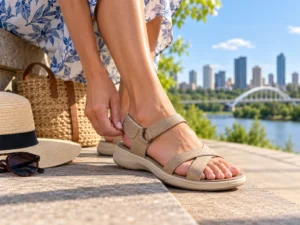
Because custom orthotics take up space and change the volume of the shoe, adjustability is critical. Look for sandals with multiple points of adjustment—specifically over the toes, across the instep, and around the heel. Buckles, Velcro, or hook-and-loop closures allow you to lock your foot securely down against the orthotic, completely eliminating the need for your toes to “grip” the shoe.
4. A Rigid Sole
If you can take a sandal in your hands and easily bend it completely in half, or twist it like a wet towel, put it back on the shelf. A sandal must have a firm, rigid sole with a built-in shank to prevent the foot from bending inappropriately during your stride.
Organizations like the American Podiatric Medical Association (APMA) explicitly warn against ultra-flexible summer footwear, noting that a rigid sole is vital for shock absorption and stability.
Top Brands for Orthotic-Friendly Summer Footwear
Finding sandals that accommodate orthotics used to mean sacrificing style for clunky, unappealing medical shoes. Thankfully, footwear fashion has evolved. Today, many premium brands engineer beautiful, modern sandals explicitly designed to hide custom orthotics.
While we carry a wide selection right in our Edmonton clinic, here are a few industry-leading brands known for their orthotic-compatible summer designs:
- Naot: Famous for their premium leathers and cork footbeds, many Naot sandals feature completely removable insoles that easily accommodate custom devices.
- Cambrian: A Canadian brand that designs some of the most robust, deeply recessed orthotic sandals on the market, perfect for heavy walking and hiking.
- Finn Comfort: Handcrafted in Germany, these are the gold standard for orthopedic footwear, offering deep footbeds and unparalleled structural support.
- Vionic: While not all Vionics have removable footbeds, they are world-renowned for having incredibly aggressive, podiatrist-designed arch support built directly into the sandal itself.
For a full list of the supportive footwear we recommend and carry, visit our brands page.
Custom Sandals vs. Orthotics in Sandals
When dealing with summer footwear, you actually have two distinct medical options depending on your budget, your insurance coverage, and your lifestyle.
Option A: Fitting Orthotics into an Orthotic-Friendly Sandal
In this scenario, we take a standard custom orthotic (often a slightly modified, lower-profile version) and fit it into a store-bought sandal that has a removable footbed.
- Pros: You can easily swap the orthotic out of the sandal and put it into your running shoes or casual loafers, making the orthotic highly versatile.
- Cons: You are limited to purchasing sandals that have removable footbeds, which slightly limits your fashion choices.
Option B: The “Custom Orthotic Sandal”
This is a premium, all-in-one solution. Instead of putting an orthotic into a sandal, the sandal is the orthotic.
During this process, we take a 3D scan of your foot. We then order a high-quality sandal (from a brand like Birkenstock or Cambrian). The lab takes the factory cork footbed, completely grinds it down, and permanently builds your custom orthotic prescription directly into the sole of the sandal, matching the original leather cover.
- Pros: Incredible, seamless comfort. There is no shifting or sliding because the device is permanently integrated. It looks exactly like a normal, high-end sandal.
- Cons: The orthotic cannot be removed and used in other shoes. It is permanently attached to that specific pair of sandals.
To understand more about the difference in manufacturing, read our breakdown of custom orthotics vs. off-the-shelf insoles.
Summer Foot Care Tips for Albertans
Wearing the right orthotics is only half the battle. Summer exposes your feet to a host of unique environmental hazards. Keep your feet healthy during the warmer months by following these expert tips:
Never Walk Barefoot in Public
Whether you are at a public pool, a splash park in the Edmonton River Valley, or a hotel shower, never walk barefoot. Warm, damp environments are breeding grounds for plantar warts (HPV) and fungal infections like Athlete’s foot. Always wear a supportive water shoe or an antimicrobial slide to protect your skin.
Sunscreen Your Feet
People meticulously apply sunscreen to their faces and shoulders, but completely forget the tops of their feet. The skin on your feet is incredibly thin and highly susceptible to severe sunburns and melanoma. Apply a broad-spectrum SPF 30 or higher to the tops of your feet and your ankles every time you wear sandals.
Manage Sweaty Feet
Summer heat causes excess perspiration, which leads to friction, blisters, and odor within your sandals. If you are not wearing socks, use a specialized foot antiperspirant or a light dusting of antifungal foot powder to keep your feet dry and reduce the risk of blister formation.
Check for Edema (Swelling)
Hot weather causes blood vessels to dilate, which can lead to fluid pooling in your lower extremities (heat edema). If your sandals feel perfectly fine in the morning but are cutting into your skin by 4:00 PM, you are likely experiencing swelling. Choose sandals with adjustable Velcro straps so you can loosen the fit throughout the day, and read our guide on steps to treat edema associated with flat feet.
The Biomechanical Assessment for Summer Footwear
If you want to ensure your summer is pain-free, the process starts with a professional assessment. Do not wait until you are already limping through your summer vacation to seek help.
When you book an appointment at Custom Orthopedic, we conduct a full clinical examination of your lower limbs. We analyze your gait, test your joint mobility, and capture a 3D volumetric scan of your foot.
If you bring your orthotic-friendly sandals to the appointment, our clinicians can perform on-site modifications, grinding and shaping the orthotic to ensure it fits perfectly within the recessed cavity of your summer shoes without bulging or slipping. If you want to know exactly what this looks like, review what happens during a custom orthotics fitting.
Maximize Your Summer (And Your Insurance) This Summer With Custom Orthotics With Sandals
Don’t let the fear of foot pain keep you trapped in heavy sneakers all summer long. By understanding the biomechanics of footwear and knowing exactly what features to look for, you can safely and comfortably wear custom orthotics with sandals.
Furthermore, if you have extended health benefits, the custom orthotics required for your sandals are typically covered! Use your benefits to invest in a dedicated summer pair so you aren’t forced to constantly swap insoles between your running shoes and your sandals.
Ready to step into summer with confidence? Contact Custom Orthopedic today to schedule your biomechanical assessment. Let our experts build the perfect foundation for your summer wardrobe so you can enjoy every hike, patio, and festival completely pain-free.