Custom orthotics for runners can make the difference between chasing the runner’s high and constantly battling nagging injuries. For many runners, there is no feeling quite like that mental clarity and energy that comes from a great run. Whether you are training for the Edmonton Marathon, enjoying a crisp morning jog through the River Valley, or sprinting intervals at the Kinsmen Sports Centre, running is as much about your mind as it is about your body.
That high can disappear fast when you feel the familiar sharp twinge in your shin or the dull ache in your knee that refuses to go away.
Running is a high impact sport. While it strengthens your heart and lungs, it places heavy demand on your feet and legs. At Custom Orthopedic, we often see athletes who try to push through the pain, only to end up sidelined for months.
This guide is designed to keep you on the road. We will break down the biomechanics of running, simplify the confusing world of technical footwear, and show how preventing running injuries starts with the most important foundation of all, your feet.
The Biomechanics of Speed: Walking vs. Running
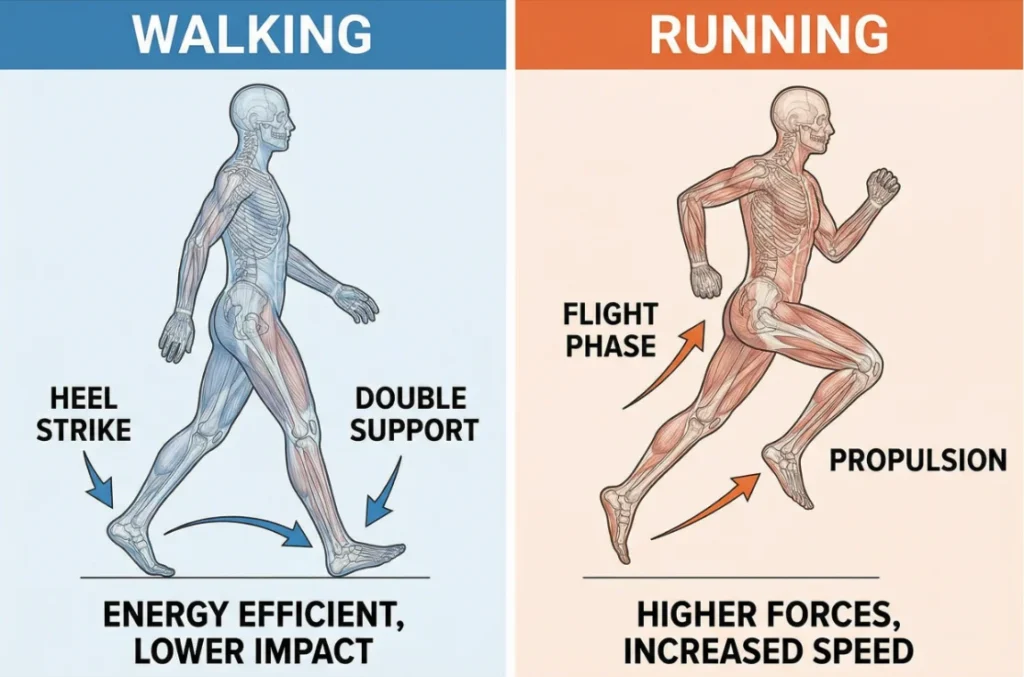
To understand why runners get injured, you first need to understand how running differs from walking. It isn’t just “fast walking.” It is a completely different biomechanical event.
The Flight Phase
When you walk, one foot is always in contact with the ground. This provides stability and distributes weight relatively evenly. When you run, you enter what is called the “flight phase.” For a split second during every stride, both feet are off the ground. When you land, you aren’t just supporting your body weight; you are absorbing the force of gravity accelerating that weight.
The Math of Impact:
- Walking: Exerts approximately 1.2x your body weight on your foot.
- Running: Exerts approximately 3x to 4x your body weight on your foot.
If you weigh 150 lbs, your foot absorbs roughly 450 lbs of force every single step. Over the course of a 5km run, that adds up to tons of cumulative force. If your foot structure is slightly misaligned—say, you overpronate (roll in) or supinate (roll out)—that force isn’t absorbed properly. Instead, it travels up the chain, wreaking havoc on your shins, knees, and hips.
The “Big Three” Running Injuries
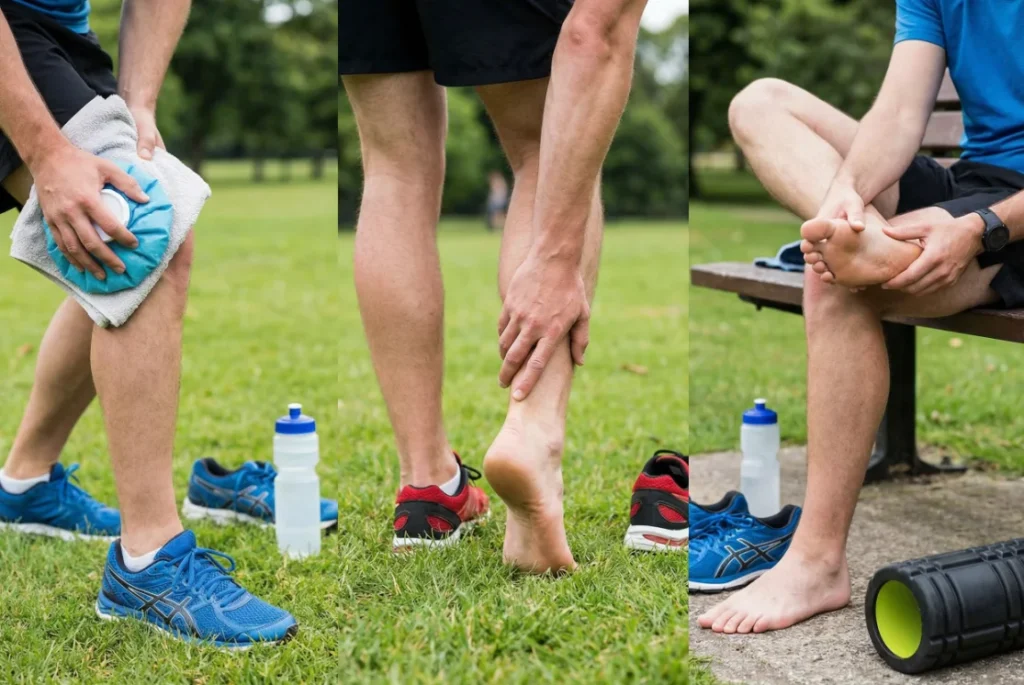
While every runner’s body is unique, three specific injuries plague the running community more than any others. Understanding the mechanics of these injuries is the first step in prevention.
1. Medial Tibial Stress Syndrome (Shin Splints)
What it feels like: A throbbing or sharp pain along the inner edge of your shin bone (tibia). The Cause: Shin splints are often an overload injury. They occur when the muscles and tendons pulling on the shin bone become overworked, causing inflammation in the periosteum (the connective tissue covering the bone). This is frequently caused by overpronation. When the foot collapses inward too much, the tibialis posterior muscle is stretched excessively, pulling violently on the shin bone with every step. Prevention Tip: Ensure your shoes have adequate arch support to limit excessive collapse.
2. Patellofemoral Pain Syndrome (Runner’s Knee)
What it feels like: A dull ache behind or around the kneecap (patella), especially when running downhill or sitting for long periods. The Cause: This is a classic tracking issue. Your kneecap is supposed to slide smoothly in a groove at the end of your thigh bone. If your feet roll inward (pronation) or your hips are weak, your thigh bone rotates internally. This causes the kneecap to grind against the side of the groove rather than gliding smoothly.
3. Stress Fractures
What it feels like: A specific, localized point of pain on a bone (often the metatarsals or shin) that worsens with activity and doesn’t go away with rest. The Cause: Unlike a traumatic break (like falling), a stress fracture is a fatigue failure. The bone is subjected to repetitive load without enough time to recover. It develops microscopic cracks that eventually become a fracture. This is common in runners who ramp up their mileage too quickly or run in worn-out shoes that have lost their shock absorption.
- External Resource: Read the Runner’s World guide on identifying stress fractures.
Demystifying Running Shoes: A Technical Guide
Walking into a running store can be overwhelming. “Drop,” “Stack Height,” “Motion Control”—what does it all mean? Here is your cheat sheet for selecting the right tool for the job.
Heel-to-Toe Drop
The “drop” is the difference in height between the heel and the forefoot.
- High Drop (10-12mm): Traditional running shoes. Good for heel strikers (most runners) as it relieves tension on the Achilles tendon.
- Low Drop (0-4mm): Encourages a mid-foot or forefoot strike. While popular in the “natural running” movement, switching to a low drop shoe too quickly can lead to severe calf strain and Achilles tendonitis.
Neutral vs. Stability vs. Motion Control
- Neutral Shoes: Designed for runners with high, rigid arches (supinators) or those with efficient biomechanics. They focus on cushioning.
- Stability Shoes: Feature a slightly denser foam on the inside of the arch to provide mild correction for overpronation.
- Motion Control Shoes: Built for severe overpronators or heavier runners. They feature a wide base and stiff heel counter to physically block the foot from rolling inward.
The “Stack Height” Trend: You may have seen runners wearing shoes with massive, thick foam soles (maximalist shoes). These offer incredible shock absorption, which can be great for older runners or those with joint pain. However, the extra height can reduce “ground feel” (proprioception), potentially increasing the risk of ankle sprains on uneven terrain.
- External Resource: A detailed breakdown of shoe anatomy from the American Academy of Podiatric Sports Medicine.
The Role of Sport-Specific Orthotics
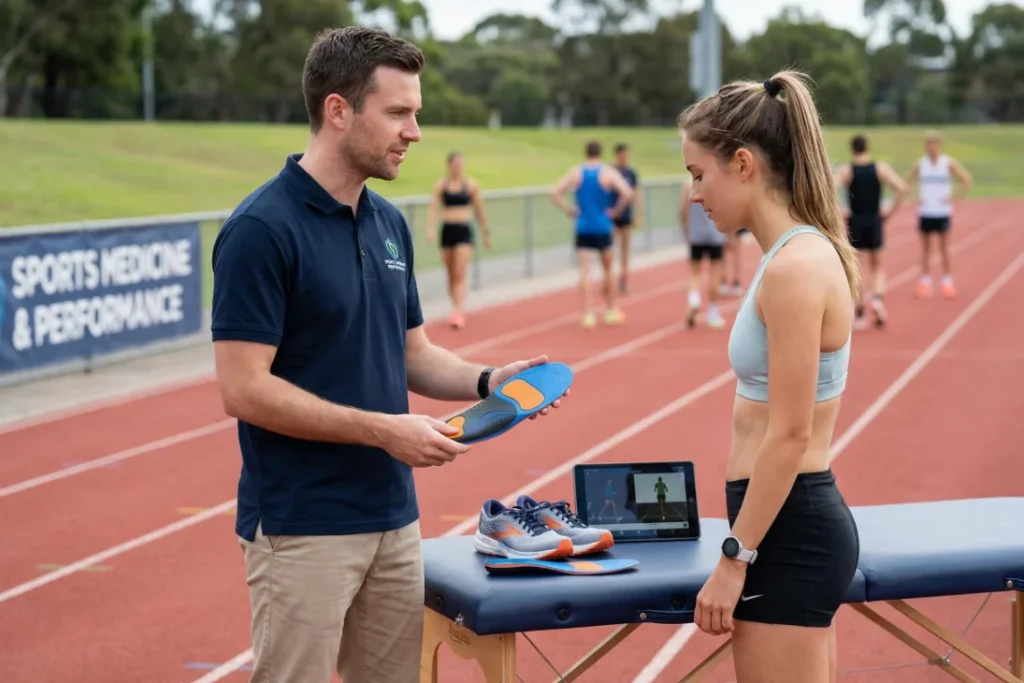
One of the biggest misconceptions we hear is, “I already have orthotics for my work boots; I’ll just put them in my running shoes.”
This is often a mistake.
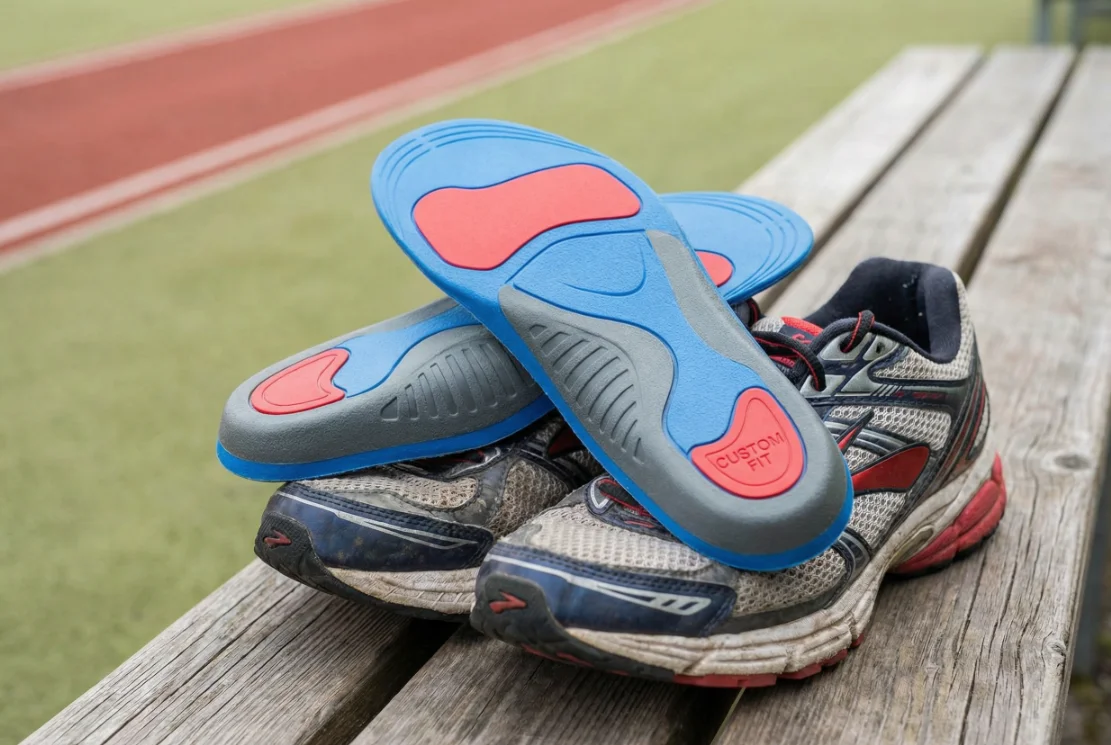
Custom Orthotics are medical devices prescription-engineered for a specific activity. The demands of standing on concrete all day are vastly different from the demands of running a 10K.
How Running Orthotics Differ
- Material Flexibility: A dress orthotic is often rigid to fit into slim shoes. A running orthotic usually utilizes semi-flexible materials like graphite or specialized polypropylene. These materials act like a spring—they deform slightly to absorb the massive impact of running, then snap back to return energy to your stride.
- Top Cover Friction: In running, friction is the enemy. Blisters can ruin a race. Sport orthotics use specific top-cover materials designed to reduce shear force and manage the intense moisture (sweat) generated during a run.
- Shock Absorption Modules: We often build specific shock-absorbing pads (like Poron or Visco-elastic polymers) into the heel and forefoot of sport orthotics to dampen the impact forces before they reach your shins and knees.
If you are a serious runner, investing in a sport-specific pair of orthotics is often cheaper than the physiotherapy bills for a chronic injury.
The Importance of Gait Analysis
You cannot fix what you cannot see. Because running happens so fast, it is impossible to analyze your own gait by looking down.
At Custom Orthopedic, we look for subtle biomechanical flaws that the naked eye misses:
- Cadence: Are you over-striding? (Taking fewer, longer steps often increases injury risk).
- Crossover: Do your feet cross the midline of your body when you land? This puts immense stress on the IT band.
- Navicular Drop: How much does your arch actually collapse under load?
Understanding these metrics allows us to tailor a solution—whether it’s a specific shoe recommendation, a custom orthotic, or a strengthening plan—that keeps you running pain-free.
When to Stop Running and Start Rehabbing
The culture of running often glorifies “toughness.” But ignoring pain is not tough; it is dangerous.
The Traffic Light Rule for Pain:
- Green Light: No pain, or mild soreness that disappears once you warm up. Keep running.
- Yellow Light: Pain that is present during the run but doesn’t alter your stride, and does not worsen as you go. Proceed with caution. Ice after running and reduce mileage.
- Red Light: Sharp pain that alters your gait (limping), pain that worsens the longer you run, or pain that persists at night. Stop immediately.
If you are stuck at a “Red Light,” rest alone might not fix the root cause. If the issue is biomechanical, the pain will return the moment you resume training.
Custom Orthotics for Runners Conclusion: Run Smarter, Not Harder
Preventing running injuries is about proactive maintenance. It’s about choosing footwear that respects your anatomy, listening to your body’s signals, and giving your feet the support they need to handle 3x your body weight.
Whether you are training for a podium finish or just running to clear your head, don’t let foot pain dictate your mileage.
Are you training for a race or dealing with nagging running pain? Book a biomechanical assessment today.