If you work in the trades, construction, warehousing, or manufacturing sectors, your feet are arguably the most critical tools in your toolkit. They are your foundation. Yet, while most workers wouldn’t hesitate to spend top dollar on high-quality power tools or heavy-duty coveralls, they often neglect the gear that supports their entire body weight for 8 to 12 hours a day.
Long shifts spent standing on concrete, climbing scaffolding, navigating uneven terrain, and carrying heavy materials can turn even the highest-quality, CSA-approved safety boots into a source of misery by the end of the day. If you are clocking out with aching feet, throbbing knees, or a stiff lower back, your footwear is likely the culprit.
Upgrading your daily gear with custom orthotics for work boots is one of the smartest, highest-return investments you can make for your body, your career longevity, and your daily comfort. In this comprehensive guide, we will explore exactly why trades workers need specialized orthotics, the common injuries they prevent, and how to choose the right safety boots to accommodate them.
The Biomechanics of the Job Site: Why Concrete Hurts
To understand why custom orthotics are so crucial, you first have to understand what happens to your body during a standard shift. Human feet were biomechanically designed to walk on natural, forgiving surfaces like dirt, grass, and sand. These surfaces naturally compress to accommodate the shape of the foot, absorbing shock in the process.
Modern industrial job sites are the exact opposite. Concrete floors, steel grating, and hard asphalt have zero “give.” When you take a step on concrete, your heel strikes the ground with a force equivalent to up to 1.5 times your body weight. Because the concrete does not absorb any of that impact, that kinetic energy is sent directly back up into your body in the form of a shockwave.
Over a 10-hour shift, this repetitive micro-trauma begins to compress the natural fat pads on the bottom of your feet. The ligaments and tendons in your arch strain to stabilize your body on the hard surface. By the end of the week, muscular fatigue sets in, leading to structural micro-tears and chronic inflammation.
Why Off-The-Shelf Work Boots Aren’t Enough
Off-the-shelf work boots are built primarily for external safety, not internal biomechanical support. Their job is to protect your toes from crushing hazards with steel or composite caps, prevent electrical shocks, and stop nails from puncturing the sole.
To keep manufacturing costs down, boot companies often insert generic, mass-produced foam insoles into the boot. These factory insoles are flat, thin, and offer almost no structural arch support. While they might feel soft when you first try them on in the store, that cheap foam fully compresses within the first few weeks on the job site.
When you use generic insoles, you are placing a unique foot—with its own specific arch height, heel width, and gait pattern—into a completely flat, unforgiving environment. Custom orthotics for work boots bridge the gap between the hard, flat interior of your safety boot and the unique contours of your foot.
If you want to learn more about how different professions require different types of support, check out our guide on occupation-specific orthotics.
The Chain Reaction: Common Work-Related Pains
Your body is a kinetic chain. When the foundation (your feet) is misaligned or poorly supported, it creates a domino effect of pain that travels upward. Ignoring foot pain on the job doesn’t just make for a miserable workday; it can lead to chronic musculoskeletal issues. Here are the most common conditions we see in tradespeople:
1. Plantar Fasciitis
This is the number one complaint among workers who stand on concrete. The plantar fascia is a thick band of tissue running across the bottom of your foot, connecting your heel bone to your toes. Standing for prolonged periods without arch support causes this band to overstretch and tear. The hallmark symptom is a sharp, stabbing pain in the heel, especially during your first steps in the morning or when getting out of your truck after a long drive.
2. Knee, Hip, and Lower Back Pain
If your foot naturally rolls inward too far when you walk (overpronation) or doesn’t roll inward enough (supination), your shin bone and thigh bone are forced to rotate unnaturally to compensate. This throws your knees and hips out of alignment, putting immense strain on your lower back. If your back is killing you after framing a house or pulling wire all day, your feet might actually be the root cause. Read more about the 5 signs your feet are messing up your knees, hips, or back.
3. Metatarsalgia (Ball of Foot Pain)
Electricians, plumbers, and roofers spend a significant amount of time crouching, squatting, or working on ladders. This places severe, localized pressure on the metatarsal heads (the ball of the foot). Without proper forefoot cushioning and a metatarsal pad, this pressure causes intense, burning pain and inflammation in the front of the foot.
4. Calluses, Corns, and Blisters
Friction is the enemy of the trades worker. If your work boot is too loose, or if your foot isn’t stabilized by an orthotic, your foot will slide back and forth inside the boot with every step. The body’s natural defense against this constant friction is to build up hard layers of skin (calluses). While calluses are normal, excessively thick ones can crack, become infected, and cause agonizing pain inside a stiff work boot.
Custom Orthotics vs. Drugstore Insoles
When foot pain strikes, many workers head straight to the pharmacy to buy over-the-counter (OTC) gel or foam insoles. While these might provide temporary relief for a few days, they are not a long-term solution for industrial environments.
Here is why custom is vastly superior for tradespeople:
- OTC insoles only provide cushioning; they do not provide correction. They are made of squishy materials that simply mask the problem.
- Custom orthotics are medical devices. They are prescribed based on a 3D mold or scan of your exact foot and a professional gait analysis. They are designed to correct biomechanical flaws, control joint movement, and properly align your skeletal structure.
- Durability. A drugstore gel insole will be destroyed in a month by a 200-pound worker carrying 50 pounds of roofing shingles. Custom orthotics are built from industrial-grade polymers and carbon fibers designed to last for years under heavy loads.
Learn more about the differences in our breakdown of custom orthotics vs. off-the-shelf insoles.
What Makes Work Boot Orthotics Unique?
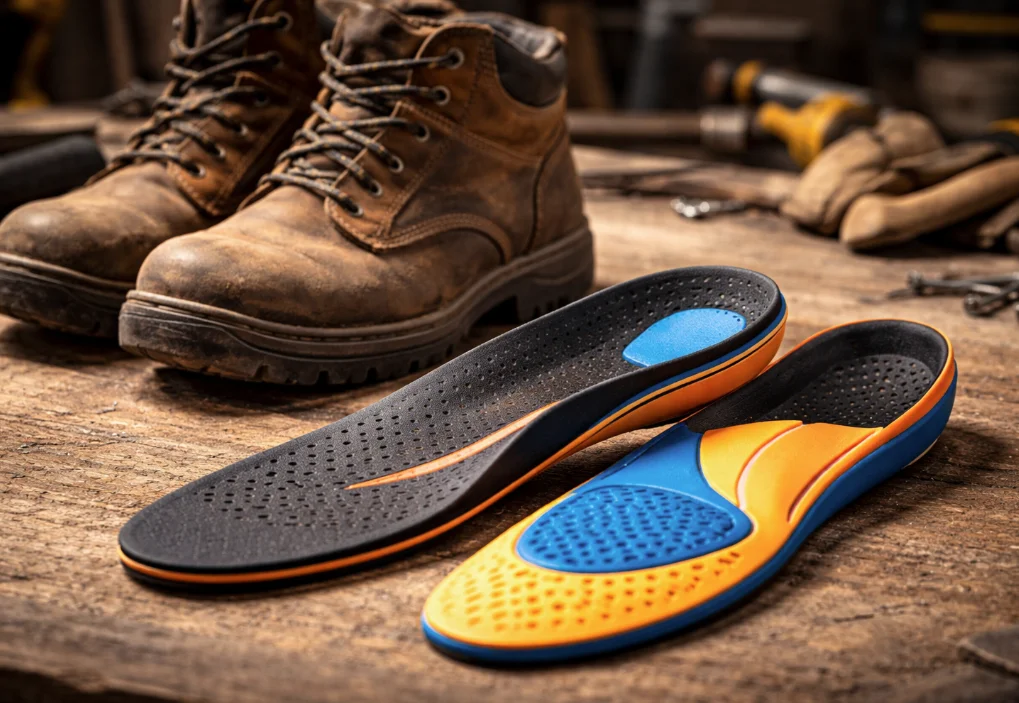
You cannot take a slim, rigid orthotic meant for a dress shoe and place it into an 8-inch steel-toed logger boot. Orthotics must be designed specifically for the footwear they will live in. Custom orthotics for work boots are uniquely engineered for the demands of the job site:
- High-Density Base Materials: Work boot orthotics utilize stronger, slightly more rigid base shells (like sub-ortholen or carbon fiber composites) that will not flex inappropriately or flatten out when you are carrying heavy loads.
- Maximum Shock Absorption: We add specialized, durable top covers (such as EVA or Spenco) that provide superior shock attenuation for walking on concrete. Extra localized cushioning can also be added to the heel strike zone.
- Deep Heel Cups: Work boots can be clunky. A deep heel cup on the orthotic firmly anchors your heel in place, preventing your foot from slipping and sliding within the spacious interior of the boot.
- Proper Volume Fit: Safety boots have a higher “volume” (more interior space) than runners or dress shoes. The orthotic is crafted to fill this space correctly so that your foot is elevated just enough for support, without squishing your toes against the steel safety cap.
How to Choose Orthotic-Friendly Work Boots
If you are planning to invest in custom orthotics, you need to ensure you are buying the right boots to house them. Bringing the wrong boots to an orthotics fitting is a common frustration. When shopping for your next pair of safety boots, keep these critical tips in mind:
1. Removable Insoles are Non-Negotiable
This is the absolute most important factor. You must be able to pull out the factory footbed. If the boot’s insole is glued down or stitched into the lining, you cannot put an orthotic on top of it, as it will drastically change the fit of the boot and crush your foot against the top leather.
2. Check the Depth and Toe Box
Ensure the boot has ample depth. Because work boot orthotics require thicker top covers for shock absorption, they take up room. You need a roomy toe box to ensure the steel or composite toe cap does not rub against the top of your toes once the orthotic is inserted.
3. Laces Trump Slip-Ons
While pull-on “rigger” style boots (like Chelseas or Wellingtons) are convenient, they are terrible for foot health. Without laces, the only way the boot stays on your foot is by fitting tightly across the top of your instep, which restricts blood flow, and by allowing your heel to slip. Lace-up boots allow you to lock your heel securely into the orthotic’s heel cup, maximizing the corrective benefits of the device.
4. Look for a Strong Shank
The shank is the stiff piece of material embedded in the midsole of the boot, right under your arch. It provides structure to the boot when climbing ladders or walking on uneven ground. A high-quality boot with a strong steel or fiberglass shank works in tandem with your custom orthotic to provide unbeatable arch support.
For comprehensive guidelines on matching your footwear to your specific workplace hazards, we highly recommend reviewing the resources provided by the Canadian Centre for Occupational Health and Safety (CCOHS). Additionally, premium workwear manufacturers like Red Wing Shoes explicitly design many of their models with extra depth and removable footbeds specifically to accommodate custom orthotics.
The Assessment and Fitting Process
Getting custom orthotics is a straightforward, medical process. At Custom Orthopedic, we don’t just ask you to step into a foam box and send you on your way.
Your appointment will include a comprehensive biomechanical assessment. We look at your medical history, assess your range of motion, and observe your gait (how you walk). We take into account your specific trade—a roofer working on steep pitches needs a different orthotic profile than a machinist standing stationary at a lathe.
Once we understand your mechanics, we take a precise 3D cast or scan of your feet. This data is sent to our lab, where your orthotics are milled and built from scratch. You can read a detailed breakdown of this process in our article: What happens during a custom orthotics fitting?
Maximizing the ROI of Your Orthotics
Custom orthotics are an investment, but they offer an incredible Return on Investment (ROI) when you factor in the cost of lost wages due to a back injury, or the hundreds of dollars spent replacing cheap drugstore insoles every month.
To get the most out of your orthotics:
- Break them in slowly: Don’t wear them for a 12-hour shift on day one. Wear them for 2 hours the first day, 4 hours the second, and gradually build up your tolerance as your muscles realign.
- Dry your boots: Work boots get sweaty. Remove your orthotics every night to allow both the boots and the orthotics to air dry. This prevents the breakdown of the materials and stops bacterial growth.
- Check your benefits: Most extended healthcare plans in Alberta cover custom orthotics. Check our insurance page for more information on how to navigate the billing and prescription process.
Stop Working in Pain Today
You rely entirely on your physical body to make a living. Foot, knee, and back pain shouldn’t just be accepted as “part of the job.” It is an occupational hazard that can be fixed.
Getting properly fitted for custom orthotics for work boots can completely transform your workday. They provide the stable, shock-absorbing foundation your body desperately needs to handle the rigors of the construction site, the shop floor, or the warehouse.
Don’t spend another long shift suffering in silence while your factory insoles let you down. Contact Custom Orthopedic today to schedule your professional assessment, and let our experts build the perfect foundation for your workday.