Considering compression socks for travel starts with understanding your needs before departure. There are bags to pack, reservations to confirm, and hours to spend getting there. Whether your July plans involve a flight from Edmonton, a long drive to visit family, or a sightseeing holiday, it is worth giving your legs some attention before departure.
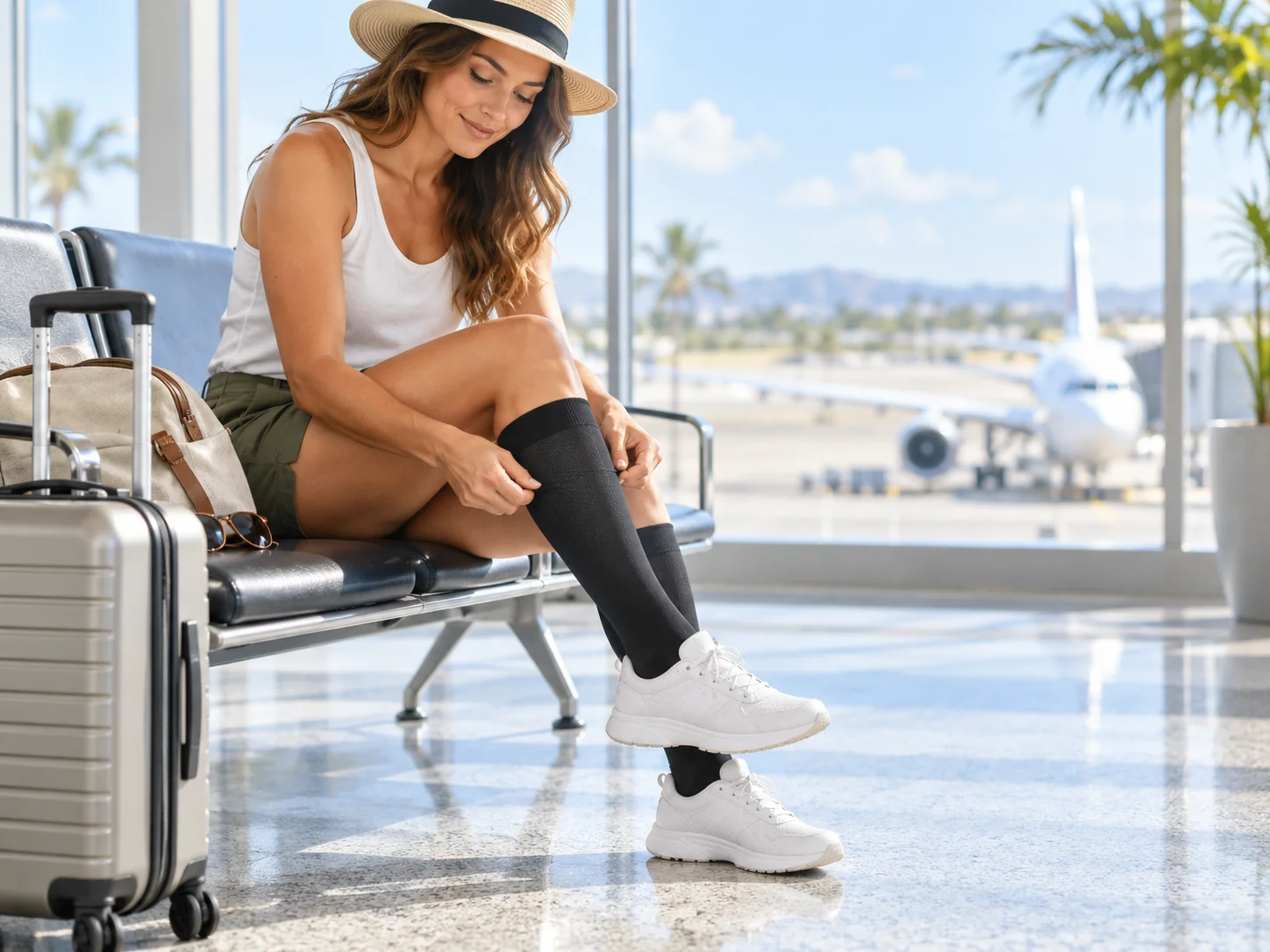
Compression socks for travel may be worth discussing as part of that preparation. However, choosing them involves more than finding your usual shoe size or picking the strongest pair on the shelf. The right approach depends on your health, the garment’s fit, and the reason you are considering compression.
This guide explains what to ask before buying, how to prepare for your trip, and which symptoms should never be dismissed as ordinary travel discomfort.
7 Essential Checks for Compression Socks for Travel
- Ask whether compression is appropriate for your health and journey.
- Confirm the recommended compression level with a qualified professional.
- Have your legs measured rather than relying only on shoe size.
- Practise putting the socks on and check the fit before departure.
- Plan comfortable clothing and follow the garment care instructions.
- Plan movement breaks during long periods of sitting.
- Know which symptoms require medical attention and who to contact.
Why Can Your Legs Feel Different During Travel?
A travel day can involve much more sitting than your normal routine. Think about the drive to the airport, waiting at the gate, the flight itself, and another journey after landing. A road trip can create a similar pattern.
Prolonged immobility can slow blood flow in the legs. Travel lasting more than four hours is associated with an increased risk of blood clots, whether the journey is by plane, car, bus, or train. For most people, that risk remains low, but personal medical factors matter. See the CDC guidance on blood clot risks during travel.
That does not mean every swollen ankle indicates a clot. It does mean that the length of your journey and your health history deserve consideration together.
When planning, look beyond the flight time printed on your booking. Write down the longest stretches you expect to spend seated and where movement breaks could reasonably fit.
What Do Graduated Compression Socks for Travel Do?
Graduated compression garments apply their greatest pressure around the ankle, with pressure decreasing farther up the leg. This helps support the return of blood through the veins towards the heart. Compression can also help manage swelling and symptoms associated with certain venous conditions.
These garments are different from ordinary socks that simply feel tight. A tight elastic cuff does not tell you that a sock provides appropriately graduated compression.
The purpose also matters. Someone considering compression for occasional travel discomfort has different needs from someone who has been prescribed it for a diagnosed condition. Neither should choose a garment solely because a friend likes the same brand.
Start with a clear question: “Am I looking for help with comfort, or has a healthcare professional recommended compression for a medical reason?” Your answer helps guide the next conversation.
Are Compression Socks for Travel Right for Everyone?
No. Compression stockings are not routinely recommended for clot prevention in every healthy traveller. Clinical guidance distinguishes people with increased clot risk from those without additional risk factors. Evidence suggests graduated compression stockings can reduce symptom-free deep vein clots during travel, but that is not the same as guaranteeing protection against a serious clot.
A previous blood clot, recent surgery or injury, active cancer, pregnancy, the postpartum period, and some hormone treatments can affect travel-related clot risk. Discuss your plans with a healthcare professional when these or other relevant medical factors apply.
Bring concrete details to that conversation: your departure date, journey length, connections, current medicines, and any previous travel-related symptoms.
Avoid turning someone else’s treatment plan into your own. Two people on the same flight can reasonably receive different advice because their medical histories are different.
When Should You Ask About Safety First?
Compression is not automatically suitable for every cause of swelling. Ask a healthcare professional before starting when you have peripheral artery disease, substantially reduced sensation in your feet or legs, fragile or damaged skin, or swelling associated with heart or kidney disease. New, unexplained swelling also deserves assessment rather than a shopping experiment.
This is especially important when you cannot reliably feel whether a garment is rubbing or pressing too firmly.
A footwear or compression fitting appointment and a medical assessment serve different purposes. Measuring helps identify a suitable garment size. It does not, by itself, establish why your leg is swollen or whether compression is medically appropriate.
Tell the fitter about relevant advice you have received, and bring a prescription when one has been provided. Do not leave an important medical detail out because it seems unrelated to buying socks.
Understanding Compression Levels and Measurements
Compression pressure is measured in millimetres of mercury, written as mmHg. You may see ranges such as 15–20 mmHg or 20–30 mmHg. These describe pressure, not sock size, and a higher number is not automatically a better choice.
Sizing can involve ankle and calf circumference, leg length, and sometimes shoe size. Measurements are commonly taken earlier in the day when swelling is lower, using the instructions for the particular garment.
Ask the person arranging your fitting when they want you to attend and whether you should bring existing stockings. A pair purchased years ago can be useful to discuss, but its label should not replace current measurements.
Before leaving, make sure you understand both decisions: the pressure you have been advised to use and the size selected for you. Keep a photograph of the packaging so those details are available during your trip.
Are All Compression Garments Interchangeable?
Compression products come in several forms, including socks, longer stockings, tights, and sleeves. Your choice should reflect the coverage recommended for your needs, not simply which item looks most convenient to pack.
Hospital anti-embolism stockings are a distinct category commonly used for people confined to bed, including after surgery. Do not automatically substitute a pair saved from a hospital stay for garments selected for your travel circumstances. Ask your healthcare professional whether they are appropriate.
When discussing options, describe how you will use them. Will you need to put them on independently in a small hotel room? Do you have difficulty reaching your feet? Will you be changing footwear during a connection?
These questions help turn a general recommendation into a workable routine. Write down the garment name and the instructions you receive, especially when you already own several different compression products.
Practise Putting Them On Before Departure
Your first attempt should not happen while a taxi waits outside.
Ask for a demonstration and try the process yourself. Compression stockings generally need to be worked over the foot and heel, then distributed evenly up the leg rather than pulled forcefully from the top. Donning gloves can improve grip and help protect the fabric from fingernails.
The garment should lie smoothly without wrinkles or a rolled-down cuff. Folding or bunching the material can create unwanted concentrated pressure. Follow the fitting and application instructions supplied with your particular stockings.
A practice session also helps you work out whether you need assistance. Explain any difficulty reaching your feet or gripping fabric, rather than assuming you simply need to pull harder.
Keep any recommended application aid with the socks when packing. Equipment left in a bathroom drawer cannot help you in a hotel room.
Planning for Warm Weather and Comfortable Clothing
Summer travel raises practical questions beyond compression strength. You may prefer a different fabric, appearance, or garment style for a business trip than for a casual holiday.
Ask what options are available within the compression and sizing requirements already established for you. Explain whether you expect to wear walking shoes, dress shoes, or another type of footwear. The aim is to select a workable combination rather than treating each item separately.
Try your intended outfit at home with your compression socks for travel. Sit down, stand up, and check whether anything feels awkward. Notice whether trouser legs make it difficult to check or adjust the socks correctly.
Do not change a prescribed compression level simply because a different product looks cooler or lighter. Bring that concern back to your healthcare professional or fitter.
Leave time between purchasing and departure to resolve practical problems. A comfortable-looking package is not the same as a garment you know how to wear.
Compression Does Not Replace Movement
Even when compression has been recommended, regular movement remains part of sensible travel preparation.
The CDC advises moving your legs frequently and walking around approximately every one to two hours during prolonged travel when possible. Seated movements can include raising and lowering your heels, lifting your toes while keeping your heels down, and gently tightening and releasing your leg muscles.
On a flight, follow crew instructions and keep your seat belt fastened when required. In a car, plan safe stops instead of leaving movement entirely to chance. Drivers should only perform activities that do not interfere with safe vehicle control.
Keep normal hydration in mind, but do not treat water as a proven method of preventing travel-related clots. Evidence does not establish that drinking extra water provides that protection.
Build these considerations into your itinerary before the day becomes rushed. A planned stop is easier to keep than one everyone has forgotten about.
Know Which Symptoms Need Medical Attention
New swelling in one leg, unexplained leg pain or tenderness, warmth, or a change in skin colour can be symptoms of deep vein thrombosis. Seek urgent medical assessment rather than assuming the problem will disappear after a walk.
Sudden shortness of breath, chest pain, coughing up blood, or fainting can indicate a medical emergency. Call emergency services immediately. During a flight, alert the cabin crew at once.
These symptoms are not something to manage by switching to stronger socks.
Separately, remove a compression garment and seek advice when wearing it causes new pain, numbness, pins and needles, or unusually cold or discoloured toes. Do not assume these changes mean the compression is working especially well.
Knowing what to watch for does not require expecting something to go wrong. It simply means having a clear response instead of trying to make a medical decision from an airport seat.
Caring for Compression Socks for Travel
Check the care label on your compression socks for travel before packing. Washing and drying instructions can differ between garments, so avoid assuming that every compression product belongs in the same laundry cycle.
For its compression stockings, Sigvaris Canada recommends gentle washing with mild detergent, avoiding bleach and fabric softener, and air drying rather than tumble drying. Follow the instructions supplied with your own product.
Consider how that will work during your trip. Will there be a place to wash the stockings? Will they have time to dry before another travel day? A second suitable pair can make the routine more manageable.
Keep clean garments separate from footwear and items that could catch the fabric. Pack a small amount of suitable detergent when appropriate, rather than relying on whatever product happens to be available.
Treat garment care as part of the packing plan, not a problem to solve when you have only one damp pair left.
Common Questions About Compression Socks for Travel
Should I Wear Them Only on the Plane?
Ask for advice that reflects the whole journey, not just the flight. Explain any long car transfers, connections, and other seated periods. Follow the wearing schedule recommended for your circumstances rather than copying a fixed number of hours from someone else’s itinerary.
Can I Sleep in Compression Socks?
Routine overnight wear is generally not recommended unless your healthcare professional advises it. An overnight flight adds a separate travel situation, so ask in advance how to follow your recommended wearing schedule during that journey. Do not interpret ordinary bedtime advice as a reason to change a prescribed travel plan yourself.
Can I Wear a Pair That Belongs to Someone Else?
Use your own measurements and the recommended compression level. Matching shoe sizes does not establish that two people need the same stocking size or pressure.
Borrowing a spare may seem convenient, but it leaves the most important fitting questions unanswered.
Should I Take Aspirin as Well?
Do not start aspirin solely to prevent travel-related blood clots. The CDC does not recommend this approach. Any medication plan for a traveller with increased clot risk should come from a healthcare professional. Do not change medicines you already take without advice.
Arrange a Fitting for Compression Socks for Travel in Edmonton
At Custom Orthopedic & The Walk Shoppe, we offer compression garments and appointments for leg measurements. Our compression socks fitting service in Edmonton explains our approach to properly measured garments and graduated compression.
Before your visit, note your travel dates, the questions you want answered, and any recommendations from your healthcare professional. Bring your existing compression socks for travel and relevant prescriptions so the discussion starts with the right information. If you are also booking a foot assessment, read what to expect at a pedorthist appointment. You can find more preparation and footwear advice in our foot health guides.
Our store is located at 10536 102 Avenue NW, Edmonton. Call 780-426-3338 or contact us to arrange a fitting before departure.
The goal when choosing compression socks for travel is straightforward: understand whether compression is appropriate, choose a properly fitted garment, learn how to use it, and leave home with fewer unanswered questions.
This article provides general information and does not replace individualized medical advice.